

Ray Tune: Optuna search
The same trainer tuned with OptunaSearch sampling the learning rate from a uniform range.
When to use it. Search spaces too big for a grid, where a model-based sampler finds good values in fewer trials.
The picture below is the graph drawn in Eugo’s visual Ray builder, and the cell under Generated code is the Ray code the builder produced from it. The code is plain Ray: it runs without the builder.
Back to the gallery · Tested with Ray 2.55.1
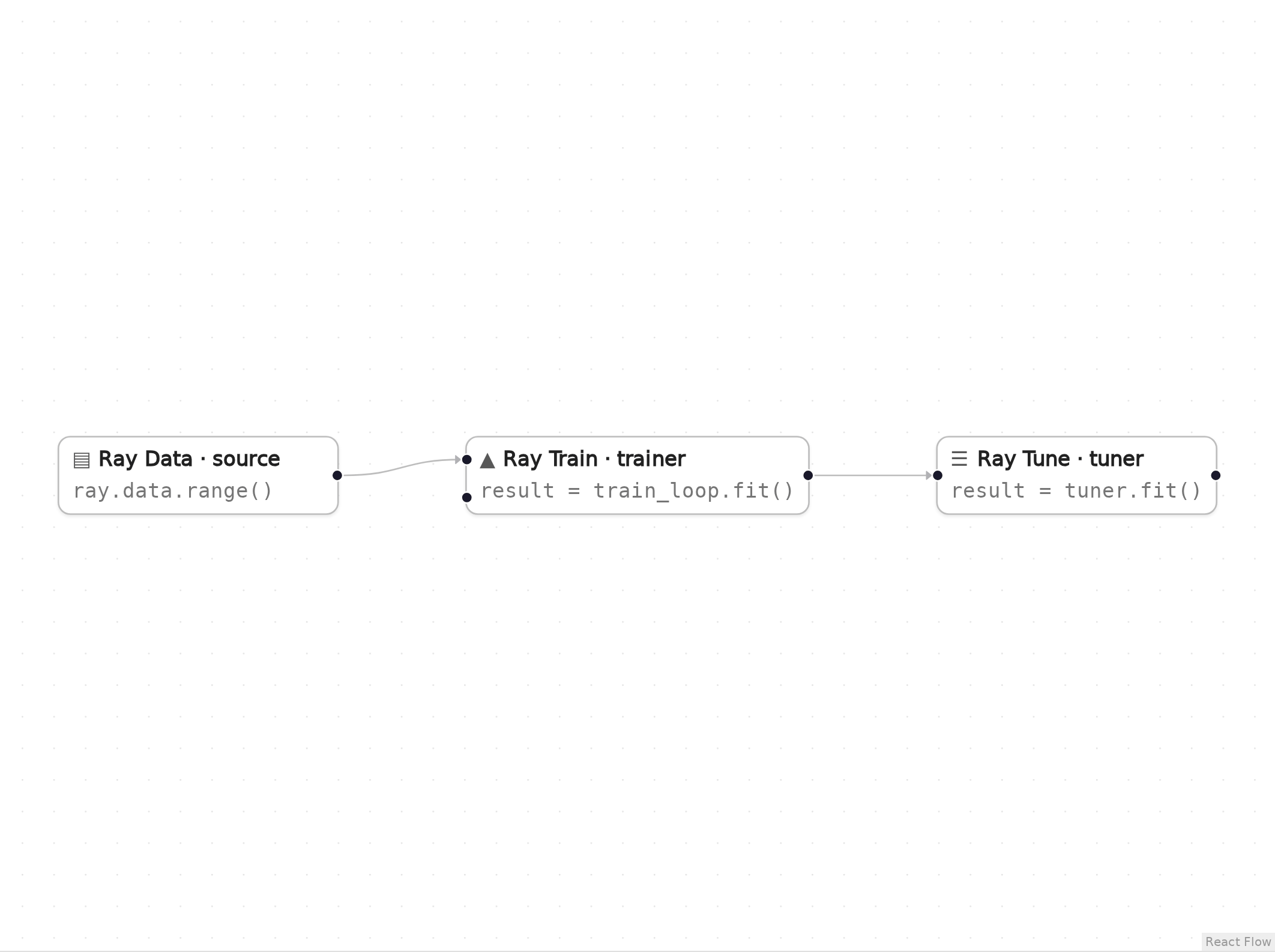
The graph in Eugo’s visual Ray builder.
Start a local Ray instance. The options keep the notebook quiet: no dashboard, and worker logs stay out of the notebook. Ray is capped at four CPUs so the example behaves the same on any machine. The generated code below only calls ray.init() when Ray is not running yet, so it reuses this instance.
import rayray.init(include_dashboard=False, log_to_driver=False, logging_level="ERROR", num_cpus=4)RayContext(dashboard_url='', python_version='3.12.3', ray_version='2.55.1', ray_commit='237c2455ebb1ea15a32dd9e1fdeb2d617badc37f')User functions
Section titled “User functions”The nodes in the graph call these ordinary Python functions and classes. In the builder you write them in a normal notebook cell, and the generated code refers to them by name.
import ray

def train_loop(config):    # Runs once per trial; config["lr"] is sampled by Optuna.    lr = config["lr"]    shard = ray.train.get_dataset_shard("train")    for _ in shard.iter_batches(batch_size=4):        pass    for i in range(5):        ray.train.report({"loss": float(lr) / (i + 1)})
Generated code
Section titled “Generated code”This is the cell the visual builder generated from the graph above.
# Generated with Eugo's visual Ray builder
from ray import tuneimport rayfrom ray.train import RunConfig, ScalingConfigfrom ray.train.torch import TorchTrainerfrom ray.tune import TuneConfig, Tunerfrom ray.tune.integration.ray_train import TuneReportCallbackfrom ray.tune.search.optuna import OptunaSearch
if not ray.is_initialized():    ray.init()
ds = ray.data.range(8)
def _tune_driver_n3(config):    trainer = TorchTrainer(train_loop, train_loop_config=config["train_loop_config"], scaling_config=ScalingConfig(num_workers=1, use_gpu=False), datasets={"train": ds}, run_config=RunConfig(callbacks=[TuneReportCallback()]))    trainer.fit()
_tuner_n3 = Tuner(_tune_driver_n3, param_space={"train_loop_config": {"lr": tune.uniform(0.01, 0.1)}}, tune_config=TuneConfig(num_samples=2, metric="loss", mode="min", max_concurrent_trials=1, search_alg=OptunaSearch()))result = _tuner_n3.fit()best = result.get_best_result()
Check the result
Section titled “Check the result”The cell below checks that the generated code did what the graph describes.
assert len(result) == 2, len(result)assert all(r.error is None for r in result), [r.error for r in result]best_lr = best.config["train_loop_config"]["lr"]assert 0.01 <= best_lr <= 0.1, best_lrprint("best lr =", best_lr)best lr = 0.038230634457359254How the graph maps to the code
Section titled “How the graph maps to the code”Each step names a node in the picture by its label, the lines of the generated cell it produced, and what those lines do. Node ids such as n1 are not drawn on the canvas. Where the builder names a variable after a node, the id is its suffix (for example _tuner_n3).
Setup (lines 1, 3–9 and 11–12)
# Generated with Eugo's visual Ray builder...from ray import tuneimport rayfrom ray.train import RunConfig, ScalingConfigfrom ray.train.torch import TorchTrainerfrom ray.tune import TuneConfig, Tunerfrom ray.tune.integration.ray_train import TuneReportCallbackfrom ray.tune.search.optuna import OptunaSearch...if not ray.is_initialized(): ray.init()The first line marks the cell as generated. The builder then adds an import for every Ray API the graph uses and a guarded ray.init(), so re-running the cell reuses the running cluster.
Source (node n1, line 14)
ds = ray.data.range(8)The dataset every trial trains on.
Tuner (node n3, lines 16, 18 and 20–22)
def _tune_driver_n3(config):... trainer.fit()..._tuner_n3 = Tuner(_tune_driver_n3, param_space={"train_loop_config": {"lr": tune.uniform(0.01, 0.1)}}, tune_config=TuneConfig(num_samples=2, metric="loss", mode="min", max_concurrent_trials=1, search_alg=OptunaSearch()))result = _tuner_n3.fit()best = result.get_best_result()tune.uniform(0.01, 0.1) defines the range and search_alg=OptunaSearch() picks the values for num_samples=2 trials.
Trainer (node n2, line 17)
trainer = TorchTrainer(train_loop, train_loop_config=config["train_loop_config"], scaling_config=ScalingConfig(num_workers=1, use_gpu=False), datasets={"train": ds}, run_config=RunConfig(callbacks=[TuneReportCallback()]))Relocated into the per-trial driver function, as in the ASHA pattern.
Clean up
Section titled “Clean up”Shut down Ray, so the next notebook starts fresh.
ray.shutdown() ganymede is made by Eugo